 support@vinstreakconsulting.ae
 +971 52
279 7715
+971 52
279 7715



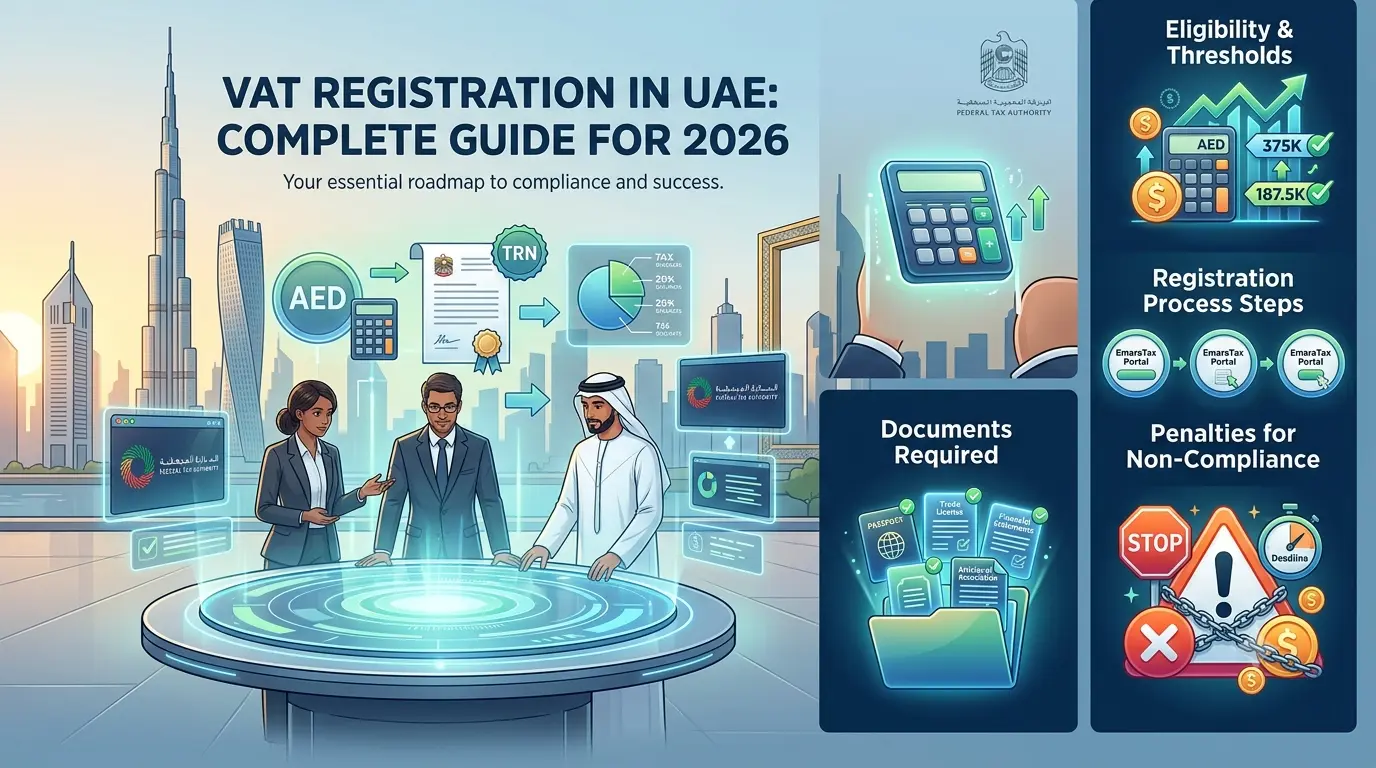
VAT Registration in UAE 2026: Complete Guide for Businesses
VAT registration is one of the most important tax compliance responsibilities for businesses operating in the UAE. Whether you run a startup, SME, mainland company, Free Zone company, e-commerce business, trading company, consultancy, restaurant, or professional services firm, you need to understand whether your business is required to register for VAT.
Waiting until turnover has significantly exceeded the registration threshold can create unnecessary compliance risks. Businesses should monitor taxable supplies and imports regularly and assess their VAT position before the applicable threshold is crossed.
Need Help With VAT Registration in UAE?
Vinstreak Consulting supports UAE businesses with VAT registration assessment, threshold review, EmaraTax applications, VAT accounting, return filing, record review, VAT deregistration, and ongoing compliance support.
What Is VAT in the UAE?
Value Added Tax, commonly known as VAT, is an indirect tax applied to supplies of goods and services according to the UAE VAT rules. VAT was introduced in the UAE on 1 January 2018.
The standard VAT rate is generally 5%, although certain transactions can be zero-rated, exempt, or outside the scope of UAE VAT depending on the circumstances. VAT-registered businesses generally collect VAT on taxable supplies where applicable and may recover eligible input VAT subject to the relevant rules and conditions.
Who Must Register for VAT in the UAE?
For a UAE-resident business, VAT registration generally becomes mandatory when the total value of taxable supplies and imports exceeds AED 375,000 during the previous 12 months.
Registration can also become mandatory where the business expects taxable supplies and imports to exceed AED 375,000 within the next 30 days. This means businesses should review both historical turnover and forward-looking sales expectations.
What Is the Mandatory VAT Registration Threshold?
The mandatory VAT registration threshold for UAE-resident businesses is AED 375,000. Businesses should not confuse this with profit. VAT registration is based on relevant taxable supplies and imports rather than accounting profit.
A company could therefore earn a relatively small profit, or even report an accounting loss, while still being required to register for VAT if its taxable supplies and imports exceed the applicable threshold.
What Is the Voluntary VAT Registration Threshold?
Some businesses that have not reached the mandatory threshold may still be eligible to register voluntarily. The voluntary VAT registration threshold is AED 187,500, subject to the applicable conditions.
Voluntary registration may be relevant to startups and growing businesses that incur significant taxable expenses before generating substantial revenue.
Mandatory vs Voluntary VAT Registration
Mandatory registration applies when a business meets the conditions requiring registration. Voluntary registration applies where the business has not reached the mandatory threshold but meets the eligibility conditions for voluntary registration.
- Mandatory VAT registration: AED 375,000 threshold for UAE-resident businesses, subject to the applicable tests.
- Voluntary VAT registration: AED 187,500 threshold, subject to the applicable conditions.
What Counts Toward the VAT Registration Threshold?
VAT registration is not determined simply by looking at all money received into the company's bank account. Businesses need to assess the value and VAT treatment of relevant taxable supplies and imports.
Accurate bookkeeping helps businesses identify standard-rated sales, zero-rated supplies where relevant, imports, exempt transactions where applicable, out-of-scope transactions where applicable, credit notes, and other adjustments that may affect the assessment.
Do Free Zone Companies Need VAT Registration?
Free Zone status does not automatically remove VAT registration obligations. A Free Zone company may be required to register when the applicable VAT registration conditions are met.
The VAT treatment of individual transactions can depend on the nature of the supply, the location and status of the parties, the type of Free Zone, and other relevant VAT provisions. Businesses should therefore assess their actual activities rather than assuming that all Free Zone transactions are outside VAT.
VAT Registration for Mainland Companies
Mainland businesses should monitor their taxable supplies and imports against the VAT registration thresholds. This can be relevant to trading companies, consultancies, restaurants, construction businesses, e-commerce businesses, marketing agencies, IT companies, professional service firms, retail businesses, and many other sectors.
VAT Registration for Non-Resident Businesses
Different rules can apply to non-resident businesses making taxable supplies in the UAE. In certain circumstances, a non-resident business may need to register regardless of the value of supplies where no other person in the UAE is responsible for paying the VAT due.
Non-resident businesses should review their UAE VAT position carefully before making taxable supplies connected with the UAE.
How to Register for VAT in the UAE
VAT registration is handled electronically through the UAE Federal Tax Authority's EmaraTax platform. A typical registration process includes:
- Create or access an EmaraTax account.
- Create or open the relevant Taxable Person Profile.
- Select the VAT registration service.
- Enter legal, commercial, contact, and financial information.
- Provide turnover and taxable-activity details.
- Upload supporting documents where required.
- Review the information carefully before submission.
Information Required for VAT Registration
The exact information and documents depend on the applicant and its circumstances, but businesses should generally be prepared with legal entity details, business activities, trade licence information, ownership or authorised signatory details, addresses, contact information, financial and turnover information, taxable activity information, and relevant supporting evidence.
Incomplete or inconsistent turnover information can delay the application, so businesses should ensure their bookkeeping records support the figures being submitted.
What Happens After VAT Registration?
Once registration is approved, the business receives a Tax Registration Number (TRN) and becomes responsible for managing the VAT obligations that apply to it.
- Issue compliant tax invoices where required.
- Record taxable sales and purchases correctly.
- Maintain VAT records and supporting documents.
- Calculate output VAT and review recoverable input VAT.
- File VAT returns within the applicable tax period deadlines.
- Pay VAT due where applicable.
Why Bookkeeping Is Important Before VAT Registration
Accurate bookkeeping makes VAT registration considerably easier because a business needs reliable financial information to determine whether it has crossed the registration threshold and when the obligation arose.
Poor bookkeeping can make it difficult to determine actual taxable turnover, identify missing invoices, classify transactions correctly, and establish when the threshold was exceeded. See our Accounting & Bookkeeping Services for ongoing support.
Common VAT Registration Mistakes
- Waiting until turnover is far above AED 375,000 before reviewing VAT.
- Looking at profit instead of taxable supplies and imports.
- Assuming Free Zone companies never need VAT registration.
- Ignoring zero-rated or other transaction classifications.
- Using incomplete bookkeeping records to calculate turnover.
- Submitting inconsistent information in the EmaraTax application.
- Registering without preparing the accounting and invoicing system for VAT.
VAT Registration Checklist for UAE Businesses
- Review whether the business makes taxable supplies.
- Calculate taxable supplies and imports for the previous 12 months.
- Assess expected taxable supplies and imports for the next 30 days.
- Determine whether mandatory registration applies.
- Consider voluntary registration eligibility where relevant.
- Review Free Zone, mainland, or non-resident status.
- Ensure bookkeeping is current.
- Prepare turnover support and business documents.
- Complete and review the EmaraTax VAT registration application.
- Prepare the accounting system for ongoing VAT compliance.
 18 September
2025
18 September
2025