 support@vinstreakconsulting.ae
 +971 52
279 7715
+971 52
279 7715



UAE Corporate Tax Deductible Expenses: What Businesses Can and Cannot Claim in 2026
Understanding which costs can reduce taxable income is essential for UAE businesses. An expense appearing in your accounting system is not automatically deductible for Corporate Tax. This guide explains common deductible, restricted and non-deductible expenses, documentation expectations and practical review steps for 2026. For professional support, explore our Corporate Tax Services and Accounting & Bookkeeping Services.
Not sure which business expenses are Corporate Tax deductible?
We can review your bookkeeping, expense classifications, supporting records, financial statements and Corporate Tax adjustments before filing.
What Is a Corporate Tax Deductible Expense?
A deductible expense is generally business expenditure that can be taken into account when determining taxable income, provided it meets UAE Corporate Tax requirements. The starting point is normally accounting net profit or loss, followed by the adjustments required under the Corporate Tax rules. Legitimate business expenses incurred to derive taxable income are generally deductible, while mixed business and personal expenses need to be apportioned.
The “Wholly and Exclusively” Business Principle
The key question is whether the expenditure was incurred for the business. Where an expense has both business and non-business purposes, only the appropriate business-related portion should generally be considered. Supporting invoices, contracts, payment evidence and a clear commercial purpose are therefore essential.
1. Salaries and Employee Costs
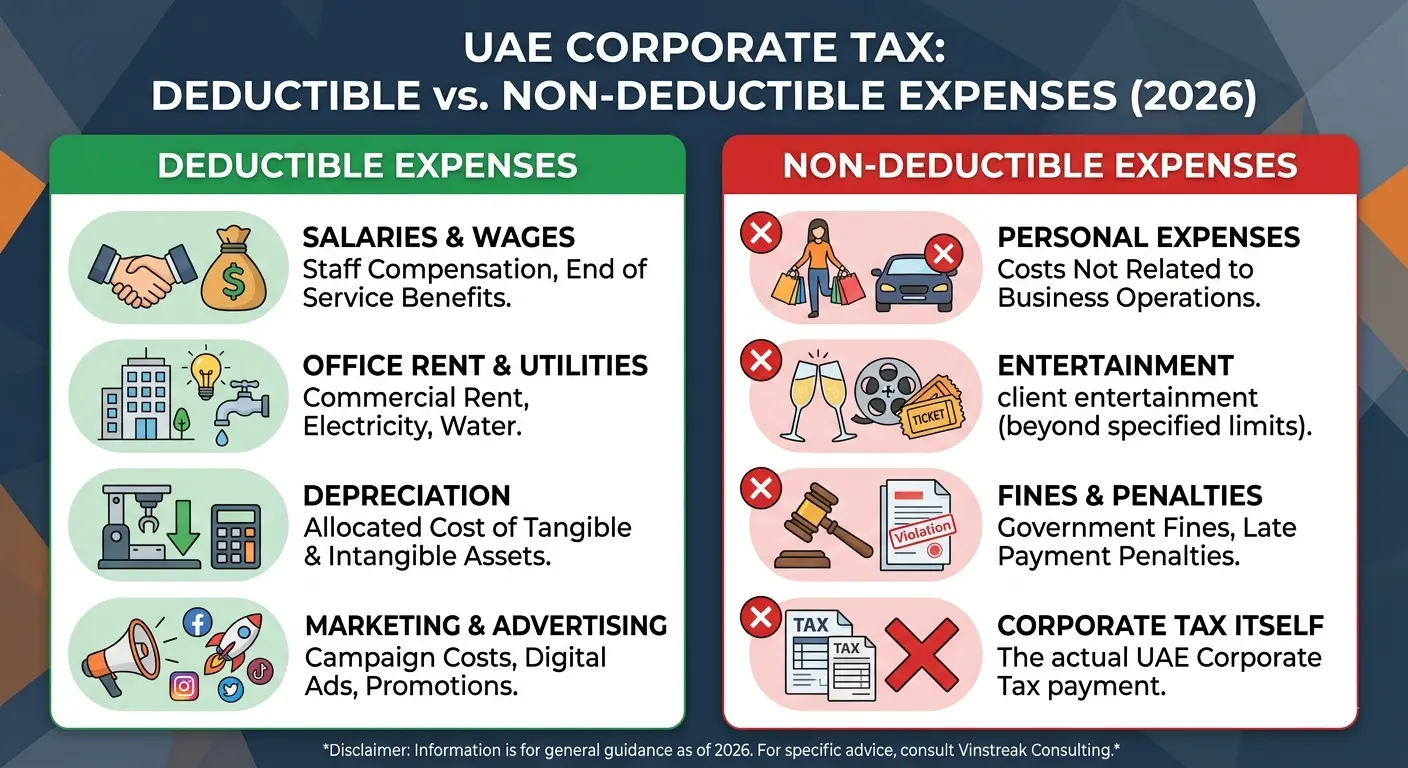
Normal employee costs incurred for legitimate business purposes may generally be deductible. These can include salaries, wages, employee benefits, bonuses, staff training, recruitment costs and business-related employee travel. Maintain employment contracts, payroll records and payment evidence. Payments to owners, directors, shareholders or other Connected Persons can require additional review.
2. Office Rent and Business Premises
Rent for premises genuinely used by the business will generally form part of ordinary business expenditure. This can include offices, warehouses, retail premises, commercial facilities, business centres and coworking facilities. Keep tenancy agreements, invoices and payment records.
3. Accounting, Audit and Professional Fees
Professional expenses incurred for business purposes may include accounting, bookkeeping, audit, tax consulting, legal services, business consulting, financial advisory and payroll services. Proper records are important because Corporate Tax calculations begin with accounting income before tax adjustments.
4. Marketing and Advertising Expenses
Legitimate marketing expenditure can generally be deductible when incurred wholly and exclusively for business purposes. Examples include online advertising, SEO, website costs, agency fees, content marketing, trade shows and sponsorship undertaken for marketing. Hospitality benefits provided to clients may instead fall under the entertainment restriction.
5. Software and Technology Expenses
Business-use accounting software, CRM systems, cloud storage, cybersecurity, ERP systems, payroll software, hosting and communication tools may generally be treated according to the applicable accounting and Corporate Tax rules. Capital expenditure may be recognised through depreciation or amortisation rather than as an immediate full deduction.
6. Business Travel Expenses
Flights, accommodation, taxis, conference travel and client-site visits can potentially qualify when genuinely incurred for business purposes. Keep evidence of the commercial purpose. If a trip combines business and personal activities, the expenditure may need to be apportioned.
7. Entertainment Expenses — The Important 50% Rule
Only 50% of qualifying entertainment expenditure incurred for customers, shareholders, suppliers or other business partners is generally deductible. Entertainment can include meals, accommodation, transportation, admission fees and related facilities. Classification matters: appropriate staff entertainment can be fully deductible, while personal entertainment may be entirely disallowed.
8. Interest and Financing Expenses
Interest can be deductible, but UAE Corporate Tax contains general and specific interest deduction limitations. Where the general limitation applies, net interest deductions can be restricted by reference to 30% of EBITDA, subject to the applicable threshold and other rules. Certain Related Party financing can also require special review.
9. Depreciation and Capital Assets
Purchasing machinery, computers, furniture, vehicles or certain intangible assets does not necessarily create an immediate full tax deduction. Capital expenditure is generally reflected through the accounting treatment, including depreciation or amortisation, with Corporate Tax adjustments applied where required. Maintain an accurate fixed-asset register.
10. Bad Debts
The treatment of bad debts depends on the facts, accounting treatment, evidence and applicable tax rules. Maintain invoices, receivable ageing, collection correspondence, write-off approvals and evidence supporting recoverability assessments.
Which Expenses Are Non-Deductible for UAE Corporate Tax?
Specific expenditure can be disallowed or restricted. Important examples include bribes, certain fines and penalties, expenditure incurred in deriving exempt income, personal expenditure and other amounts specifically restricted by the Corporate Tax Law.
Government Fines, Penalties and Illicit Payments
Bribes are not deductible. Fines and penalties imposed as punishment for breaches of laws, rules or regulations are generally non-deductible. Businesses should distinguish statutory penalties from ordinary commercial or contractual payments, whose treatment depends on their nature.
Donations and Gifts
Donations, grants and gifts made to persons other than Qualifying Public Benefit Entities are generally non-deductible. Businesses should therefore confirm the status and nature of a contribution before assuming it reduces taxable income.
Personal and Mixed-Purpose Expenses
Personal holidays, household costs, family entertainment, personal shopping and other private expenditure should not be claimed as business deductions. If an expense has both business and personal purposes, identify and document the qualifying business portion.
Expenses Related to Exempt Income
Expenditure incurred in deriving exempt income is generally not deductible against taxable income. Businesses earning both taxable and exempt income should maintain records that support the allocation of relevant expenses.
Why Expense Classification Matters
An amount recorded as an accounting expense is not automatically fully deductible for Corporate Tax. It may be fully deductible, partially deductible, non-deductible, capital in nature, connected with exempt income, subject to interest restrictions, personal, or affected by Related Party and Connected Person rules.
Example: Accounting Profit vs Taxable Income
Assume a UAE company has accounting profit of AED 800,000. It also recorded AED 20,000 of non-deductible government penalties, AED 40,000 of qualifying client entertainment, and AED 15,000 of personal shareholder expenses. A simplified adjustment would add back AED 20,000 of penalties, AED 20,000 representing the non-deductible 50% of entertainment, and AED 15,000 of personal expenses. Before any other adjustments, the resulting amount would be AED 855,000. This is an illustration only; actual taxable income may require further adjustments, exemptions, reliefs or restrictions.
Documentation Businesses Should Maintain
Keep supplier and tax invoices, contracts, bank statements, payment confirmations, expense claims, payroll records, employment agreements, travel records, entertainment records, loan agreements, fixed-asset registers, accounting ledgers and financial statements. Relevant Corporate Tax records should generally be retained for at least seven years following the end of the relevant Tax Period.
Create a Corporate Tax Expense Review Process
Review personal or shareholder expenses, entertainment, fines, Related Party transactions, unusual payments and missing documents monthly. Quarterly, review fixed assets, interest, bad debts, accruals and expense classifications. Before filing, reconcile accounting profit to Corporate Tax adjustments and taxable income.
Why Accurate Bookkeeping Is Critical
Corporate Tax compliance starts with reliable accounting. Incomplete bookkeeping makes it difficult to identify deductible and non-deductible expenses, Related Party transactions, entertainment adjustments, fixed assets, interest costs, personal expenditure and costs linked to exempt income. Monthly reconciliations make year-end Corporate Tax preparation significantly easier.
Common Corporate Tax Expense Mistakes
- Claiming personal expenses as business expenses.
- Deducting 100% of restricted client entertainment.
- Treating government penalties as deductible.
- Recording expenses without invoices or evidence.
- Ignoring Related Party and Connected Person transactions.
- Misclassifying capital expenditure as ordinary expense.
- Failing to reconcile accounting records before filing.
Corporate Tax Expense Checklist
- Was the expense incurred for the business and supported by a genuine commercial purpose?
- Are invoices, contracts and payment evidence available?
- Is any portion personal or connected with exempt income?
- Is it entertainment, a fine, a donation, capital expenditure or interest?
- Does it involve a Related Party or Connected Person?
- Has it been correctly recorded and reviewed before filing?
 18 September
2025
18 September
2025