 support@vinstreakconsulting.ae
 +971 52
279 7715
+971 52
279 7715



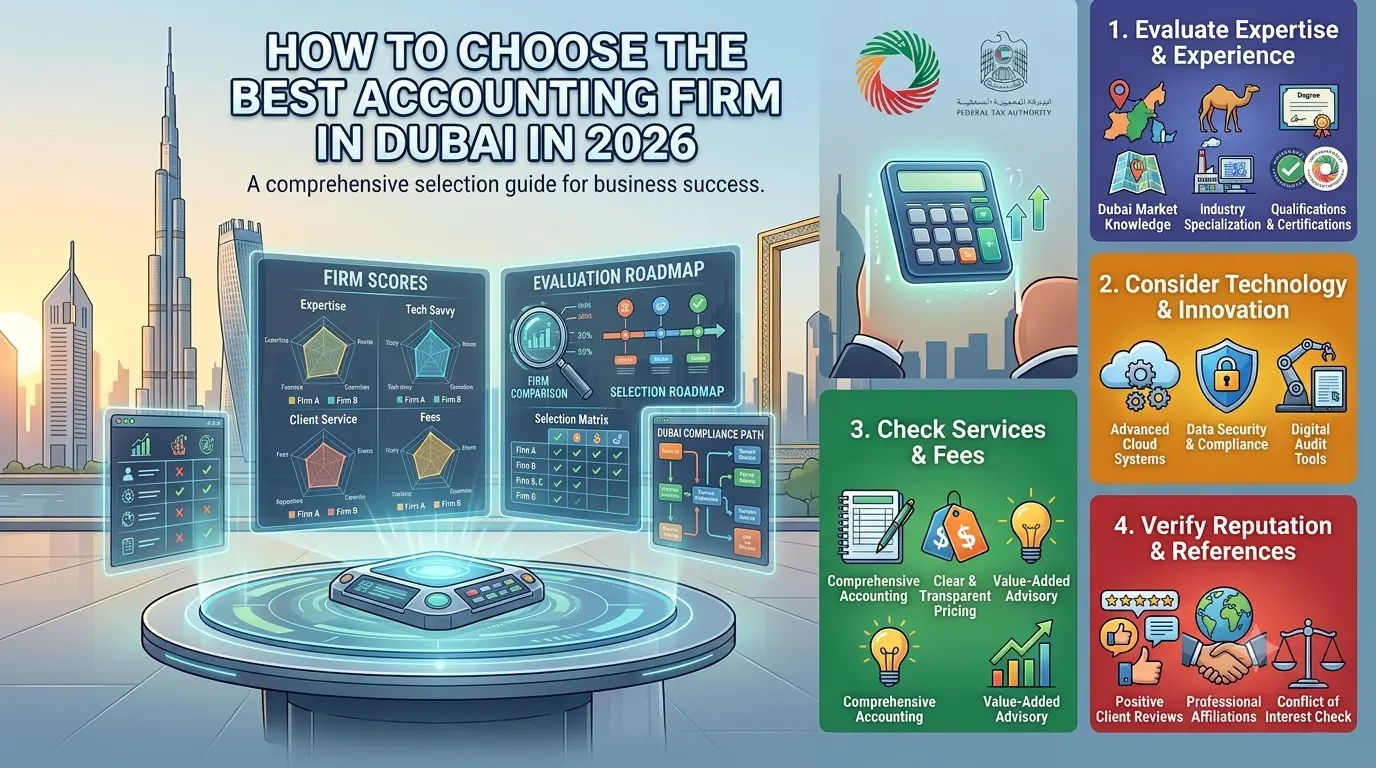
How to Choose the Best Accounting Firm in Dubai in 2026
Choosing an accounting firm is an important decision for any business operating in Dubai. The right accounting partner can help your company maintain accurate financial records, monitor cash flow, prepare management reports, support VAT and Corporate Tax processes, and provide management with clearer financial information.
The best choice is not necessarily the largest firm or the lowest-priced provider. It is the firm that matches your business size, transaction volume, industry, reporting requirements, tax obligations, internal resources, and growth plans.
Looking for a Reliable Accounting Firm in Dubai?
Get professional support with bookkeeping, bank reconciliation, financial reporting, VAT, Corporate Tax, payroll-related accounting, and Virtual CFO services tailored to your UAE business.

Why Choosing the Right Accounting Firm Matters
Reliable accounting records support financial reporting, cash flow monitoring, budgeting, expense control, accounts receivable, accounts payable, VAT preparation, Corporate Tax preparation, audit readiness, management decisions, and business planning.
An accounting firm should therefore do more than enter transactions into software. It should help create a reliable financial process and provide information that management can use.
Start by Defining What Your Business Needs
Before comparing accounting firms, define the services your business actually requires. Some companies only need monthly bookkeeping and bank reconciliation, while others need a complete outsourced finance function.
- Daily or monthly bookkeeping.
- General ledger maintenance.
- Bank and credit card reconciliation.
- Accounts payable and receivable management.
- Payroll-related accounting.
- Financial statements and management reporting.
- VAT registration and return support.
- Corporate Tax registration and return support.
- Budgeting, forecasting, audit preparation, and Virtual CFO services.
1. Check the Firm's Experience With UAE Businesses
The accounting firm should understand the operating environment of UAE companies. Ask whether it works with mainland companies, Free Zone companies, startups, SMEs, foreign-company branches, e-commerce businesses, trading companies, professional services firms, restaurants, construction businesses, technology companies, and multi-entity groups.
Relevant UAE experience can help the provider understand common issues involving local banks, VAT, Corporate Tax, Free Zone structures, imports, exports, payroll, WPS, shareholder transactions, and related-party balances.
2. Evaluate Industry Experience
Accounting processes vary by industry. A trading company may require inventory accounting, supplier reconciliation, receivable monitoring, import documentation, landed-cost calculations, and multi-currency accounting.
E-commerce businesses may require marketplace reconciliation, payment-gateway reconciliation, refund tracking, platform-fee accounting, and high-volume transaction processing. Service businesses may need project profitability, retainer accounting, and contract-based revenue tracking.
3. Confirm UAE VAT and Corporate Tax Knowledge
A Dubai accounting firm should understand how accounting records support VAT and Corporate Tax compliance. For VAT, the firm should be able to manage tax codes, tax invoices, input VAT, output VAT, credit notes, VAT control accounts, reconciliations, and return-supporting schedules.
For Corporate Tax, the firm should organise revenue, expenses, fixed assets, shareholder transactions, related-party balances, loans, supporting documents, general ledger balances, and financial statements. Explore our Corporate Tax Services and VAT Registration & Filing Services.
4. Ask What Is Included in the Monthly Service
Do not assume that “monthly accounting” means the same thing at every firm. Ask for a written list of deliverables, including transaction recording, reconciliations, ledger reviews, receivable and payable reports, financial statements, VAT account review, document follow-up, and review meetings.
Confirm when the books will be updated, when reports will be delivered, who reviews the ledger, and whether corrections are included in the monthly fee.
5. Review the Firm's Bookkeeping Process
A reliable accounting firm should have a documented process for collecting documents, recording transactions, identifying missing information, reconciling bank accounts, reviewing customer and supplier balances, approving journal entries, checking reports, communicating queries, storing records, and completing month-end close.
A professional process should include review controls, not just data entry. See our Accounting & Bookkeeping Services for structured monthly support.
6. Check the Quality of Financial Reporting
Ask to see a sample reporting package with confidential information removed. Useful monthly reports may include a profit and loss statement, balance sheet, cash flow summary, accounts receivable ageing, accounts payable ageing, bank balance summary, revenue comparison, expense comparison, budget variance, and key observations.
Reports should be clear enough for owners and managers to understand. A long general ledger without explanation is not the same as a management report.
7. Evaluate Communication and Response Time
Ask who will be your primary contact, whether you will have a dedicated accountant, how quickly emails are answered, how urgent tax matters are handled, whether monthly review calls are included, and who provides backup when the assigned accountant is unavailable.
8. Ask About the Review and Quality-Control Process
Bookkeeping work should be reviewed before financial reports are issued. Ask whether the firm uses a maker-checker process and whether review procedures include bank reconciliations, unusual balances, VAT coding, journal entries, customer and supplier balances, supporting documents, and monthly movement analysis.
9. Evaluate Accounting Software Experience
The firm should be comfortable with accounting software suited to your needs, including cloud accounting, multi-currency accounting, inventory, bank feeds, payment gateways, payroll integration, project accounting, dashboards, and multi-entity reporting.
Confirm who owns the software account, who controls administrator access, how data is backed up, whether data can be exported, and what happens to access if the engagement ends.
10. Review Data Security and Confidentiality
An accounting firm may access bank statements, customer and supplier information, payroll records, contracts, tax records, and shareholder information. Ask about role-based access, secure storage, multi-factor authentication, confidentiality agreements, file-sharing methods, employee access reviews, and data-return procedures.
11. Compare Pricing and Exclusions Carefully
Accounting firms may charge fixed monthly, hourly, transaction-based, or package-based fees. Compare scope, not only price. Confirm the number of entities, transaction volume, bank accounts, currencies, payroll volume, VAT return frequency, reporting frequency, and tax services included.
Ask whether VAT registration, VAT filing, Corporate Tax registration, Corporate Tax return preparation, audit support, cleanup work, inventory reconciliation, payroll, WPS, forecasts, tax authority correspondence, software subscriptions, and on-site visits are charged separately.
12. Verify Professional Credentials and Legal Status
Ask for trade licence details, registered business name, office address, professional team profiles, relevant qualifications, service agreement, confidentiality terms, and insurance details where relevant.
Accounting and auditing are related but different services. Where statutory audit or regulated assurance work is required, confirm that the provider is appropriately authorised for that engagement.
13. Assess Whether the Firm Can Support Growth
Your needs may expand from basic bookkeeping to department-level reporting, cash flow forecasting, budgeting, multi-branch reporting, inventory analysis, project profitability, group consolidation, internal controls, audit preparation, and Virtual CFO Services.
14. Watch for Warning Signs
- Promising guaranteed tax savings without reviewing records.
- Refusing to provide a written scope.
- Failing to explain the reconciliation process.
- Quoting without understanding transaction volume or business complexity.
- Delivering reports without reviewing balances.
- Providing no clear contact or escalation process.
- Treating every Free Zone company as automatically tax-free.
Questions to Ask Before Hiring an Accounting Firm
- How many UAE businesses do you support?
- Do you have experience in our industry?
- What services are included in the monthly fee?
- How often will our books be updated and reconciled?
- What reports will we receive?
- Who reviews the bookkeeping work?
- How do you support VAT and Corporate Tax readiness?
- How is our financial data protected?
- What services are charged separately?
- How will our data be transferred if we change providers?
Accounting Firm Selection Scorecard
- UAE accounting experience — 15%
- Industry knowledge — 10%
- VAT and Corporate Tax knowledge — 15%
- Bookkeeping and reconciliation process — 15%
- Financial reporting quality — 10%
- Communication and response time — 10%
- Data security — 10%
- Software capability — 5%
- Pricing transparency — 5%
- Scalability and advisory support — 5%
Outsourced Accounting Firm vs In-House Accountant
Outsourced accounting may suit businesses that do not need a full-time finance team, want flexible support, need access to multiple skills, or prefer predictable monthly costs.
An in-house accountant may be more suitable where transaction volumes are very high, daily on-site support is essential, or the business requires continuous operational coordination. Some businesses use a hybrid model combining an internal finance coordinator with an external accounting firm.
 18 September
2025
18 September
2025