 support@vinstreakconsulting.ae
 +971 52
279 7715
+971 52
279 7715



Corporate Tax Return Filing in UAE 2026: Deadlines, Documents & Step-by-Step Guide
Corporate Tax return filing has become an essential annual compliance responsibility for businesses operating in the UAE. Registering for Corporate Tax is only the first step. Once registered, a Taxable Person must maintain appropriate accounting records, calculate Taxable Income, identify relevant tax adjustments, prepare the Corporate Tax Return, submit it through EmaraTax, and pay any Corporate Tax due within the applicable deadline.
This guide explains Corporate Tax Return Filing in UAE in 2026, including filing deadlines, documents, tax calculations, EmaraTax filing, Small Business Relief, common filing mistakes, record-keeping requirements, and how businesses can prepare before submission.
Need Help Filing Your UAE Corporate Tax Return?
Get professional support with accounting review, tax adjustments, Taxable Income calculation, Small Business Relief assessment, Free Zone review, EmaraTax filing and Corporate Tax payment preparation.
What Is a UAE Corporate Tax Return?
A Corporate Tax Return is the formal declaration submitted by a Taxable Person to the UAE Federal Tax Authority for the relevant Tax Period. It reports the information required to determine the taxpayer's Corporate Tax position.
Corporate Tax registration establishes the taxpayer with the FTA, while return filing reports the tax position for a specific Tax Period.
Who Must File a Corporate Tax Return in the UAE?
Taxable Persons subject to UAE Corporate Tax generally have a return filing obligation for each applicable Tax Period.
- UAE mainland companies.
- Free Zone companies.
- Limited liability companies and private companies.
- Professional, trading and service businesses.
- Certain natural persons and non-resident persons.
What Is the Corporate Tax Filing Deadline in the UAE?
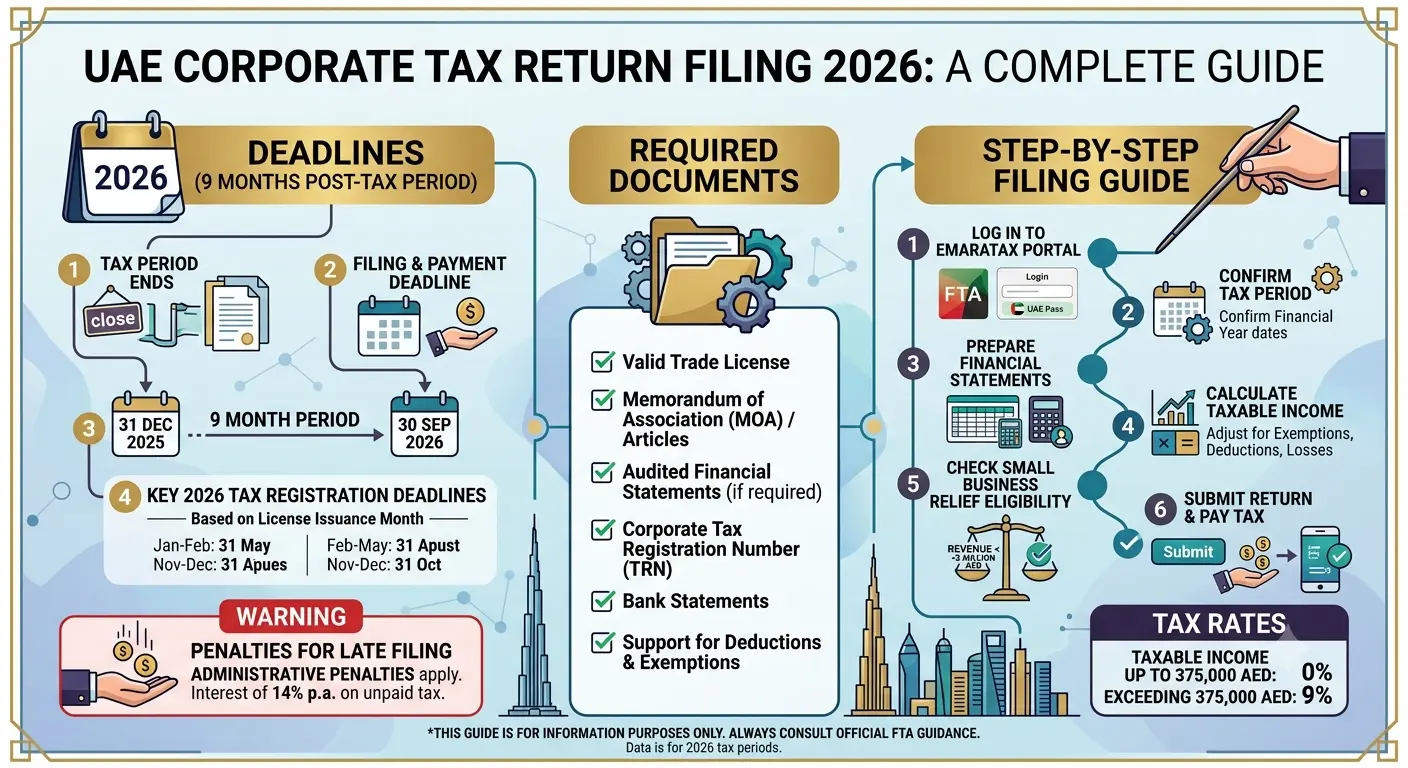
Corporate Tax Returns must generally be filed within nine months from the end of the relevant Tax Period. Any Corporate Tax payable is also generally due within the same nine-month period.
- 31 December 2025 year-end → 30 September 2026.
- 31 March 2026 year-end → 31 December 2026.
- 30 June 2026 year-end → 31 March 2027.
Important September 2026 Corporate Tax Deadline
Businesses with a financial year ending 31 December 2025 should pay particular attention because the general filing and payment deadline is 30 September 2026.
Where Is the Corporate Tax Return Filed?
Corporate Tax Returns are filed electronically through the FTA's EmaraTax platform. Businesses should confirm access to the correct Taxable Person profile well before the deadline.
What Should You Prepare Before Filing?
- Trial balance and general ledger.
- Profit and loss statement and balance sheet.
- Bank reconciliations.
- Revenue and expense schedules.
- Fixed asset and depreciation schedules.
- Loan and payroll information.
- Related Party and shareholder transactions.
- Tax-loss information and Corporate Tax registration details.
Corporate Tax Return Filing: Step-by-Step Process
- Step 1: Confirm Corporate Tax registration and TRN.
- Step 2: Confirm the correct Tax Period.
- Step 3: Finalise accounting records and bank reconciliations.
- Step 4: Prepare financial statements.
- Step 5: Review business expenses.
- Step 6: Identify non-deductible or restricted expenses.
- Step 7: Review Related Party transactions.
- Step 8: Calculate Taxable Income.
- Step 9: Calculate Corporate Tax payable.
- Step 10: Review Small Business Relief where relevant.
- Step 11: Review Free Zone treatment where applicable.
- Step 12: Review tax losses.
- Step 13: Complete the Corporate Tax Return in EmaraTax.
- Step 14: Review all figures and disclosures.
- Step 15: Submit the return.
- Step 16: Pay Corporate Tax due within the deadline.
Small Business Relief and Corporate Tax Filing
Eligible Resident Persons with Revenue not exceeding AED 3 million in the relevant Tax Period and all previous relevant Tax Periods may potentially elect for Small Business Relief, subject to the applicable conditions. The election is made through the Corporate Tax Return, so relief does not mean there is no filing obligation.
Corporate Tax Filing for Free Zone Companies
Free Zone companies should assess Qualifying Free Zone Person requirements, Qualifying Income, Excluded Activities, de minimis conditions, adequate substance, transfer pricing, financial statements and any applicable audit requirements.
What Records Must Businesses Keep?
Relevant records and supporting documentation should generally be retained for at least seven years following the end of the relevant Tax Period. These can include accounting records, invoices, receipts, contracts, bank statements, tax calculations and supporting schedules.
Common Corporate Tax Filing Mistakes
- Waiting until the deadline.
- Filing from unreconciled accounts.
- Treating every accounting expense as tax deductible.
- Ignoring Related Party transactions.
- Assuming 0% means no return.
- Assuming Small Business Relief means no filing.
- Assuming Free Zone status means no filing.
- Using the wrong Tax Period.
- Forgetting Corporate Tax payment.
Corporate Tax Filing Checklist for UAE Businesses
- Confirm registration, TRN and Tax Period.
- Finalise bookkeeping and bank reconciliations.
- Prepare financial statements.
- Review deductible and non-deductible expenses.
- Review Related Party transactions and tax losses.
- Check Small Business Relief eligibility.
- Review Free Zone treatment where applicable.
- Calculate Taxable Income and Corporate Tax payable.
- Complete, review and submit the EmaraTax return.
- Pay Corporate Tax due and retain evidence.
Why Accounting and Bookkeeping Matter for Corporate Tax
Corporate Tax calculations rely heavily on accounting information. Incomplete bookkeeping can make it difficult to determine correct revenue, expenses, tax adjustments, receivables, payables, fixed assets, loans, Related Party balances and Taxable Income. For ongoing support, explore our Accounting & Bookkeeping Services.
Corporate Tax Registration vs Corporate Tax Filing
Corporate Tax registration establishes the taxpayer with the FTA and results in a Corporate Tax Registration Number. Filing reports the taxpayer's Corporate Tax position for a particular Tax Period.
Why Businesses Should File Early
Early preparation gives businesses time to correct accounting errors, obtain missing invoices, reconcile bank accounts, review expenses, analyse Related Party transactions, assess reliefs, resolve Free Zone questions, review Taxable Income and arrange Corporate Tax payment.
 18 September
2025
18 September
2025